C is for 'Condition'; I is for 'Interpretations may vary'!

Opinions still vary when it comes to determining the condition of a Bond book. Recently I saw a title being advertised with a comic-style grading system. Will it catch on?

Two years ago, in my very first blog for this website, I talked about an issue that still nags at me today – the subjective world of book grading.
We all know one person’s ‘fine’ is another person's ‘average’, but blatant misdescriptions (that is a word!) – where the images seem to bare no relation to what the eye can see – continue to displease me.
And don’t even get me started on the oft-used phrase ‘very good for its age’ (more on this later)...
At the time I wrote my blog, I suggested that wouldn’t it be a good idea if booksellers used a similar grading system as those who sell comics.
The 10-point system used to describe rare comics is extremely precise, with a whopping 25 different levels of condition between 0.5 (‘Poor’) and 10.0 (‘Gem Mint’).
The system widely accepted as the best is that devised by Comics Guaranty, LLC (CGC) (see picture above).
In this scale of grading, each successive level of quality goes up in tiny 0.5 increments, before reaching 9.0, after which the grading gets even more precise, going up in increments of 0.2 between 9.0 and 9.8, and then there’s even a 9.9 and finally a 10.
The level of granularity that the comic world goes to is in stark contrast to the book world.
‘Very good’ in the comic world [a common descriptor to describe what most of us would call a superior-condition book in bookselling], would only get an official comic book grade of 3.5 out of ten. In comics, ‘fine’ starts at only 5.0 in the scale.
After five, there are whole other new layers, ranging from ‘fine+’ (6.5) to ‘Very Fine’ to VeryFine+ (8.5), and the word mint doesn’t start being used until 9.0 (after which there six levels of ‘mintness’).
Would this work with books?
Now, in case you’ve not seen that first blog, I have already noted that I didn’t think this level of granularity would work too well for books.
Most obviously, books have two constituent parts – the book itself and the jacket – and conditions of each can vary.
At a stretch, you could grade a jacket like a comic, but the problem with using an official grading system like this is that if it’s to mean anything, any item being graded needs assessing by an actual professional organisation, using independent assessors (ie not the merchant trying to sell it themselves).
The value collectors place on a comic (or baseball card or the like) being gauged to a certain level, is that it has reached a rigorously and independently-established level - one that has determined with no favour. In theory, if the same item assessed by someone else, the exact same standard of condition would be given.
Does this grading have legs with books?
Notwithstanding the fact that booksellers can’t send every book they own for professional assessment, is the fact that books are (and should) be much more tactile items – not sealed up in a perspective sleeve, never to be touch again.
That means handling a book will affect its condition over time – and that’s fine. It’s how it should be.
However, all this preamble does have a point to it, because recently I saw a listing on eBay – for an Ian Fleming book – where the seller had indeed attempted to apply a comic-style level of grading to their listing.

This is the item – this 1968 paperback of Octopussy & The Living Daylights – where the book is given a 7.0 comic-book style rating (see above):
At first I was somewhat impressed – here is a seller, who is attempting to take some of the subjectivity out of determining condition, by applying the principles of comic book grading to their listing.
My most immediate thought was that this was a great idea, and that maybe (just maybe), this could be the start of a change in approach to determining condition that would be seen and copied by others.
After all, no one wants to sell books that get returned because condition didn’t meet expectation. I was heartened too by the fact the seller actually said they normally sell comics, so the reason for the grading was down to describing comic books for a living.
Here’s what the seller says:
Octopussy by Ian Fleming – Pan (1968) 2nd printing. Uncreased spine. Tight binding throughout. Tanning. Edge wear.
Grade: (7.0)
NOTE: I use the same (CGC inspired) 10 point grading scale for books as I do for my comic book listings, so as not to confuse customers with two different grading systems, despite the collectable book trade typically using a simpler grading system where FINE is the highest grade.
The (7.0) grade on this listing corresponds with Very Good Plus in book collecting terms.
So...not quite what I thought!
In my estimation what this seller seems to actually be saying is that the grading they’ve applied is a ‘CGC-inspired’ one – not actually the real CGC one.
A 7.0 (using the proper CGC scale), would be ‘Fine/VeryFine’ and I’m not sure this book is that.
In fact, as the seller admits, they equivalise their score to ‘very good plus’ (which would only be a comic book score of 4.5 – so a difference of 2.5 points, quite a lot!).
So what we can really see, is that this seller is actually applying a type of grading, one that is claimed to then apply differently in books!
Coming down to earth
So, after the initial thrill of seeing what I thought was the first real attempt to grade books like comics, I do feel a little bit deflated. The seller even seems to accept themselves, that books aren’t comics, and only a rough comparison should be made.
But, on the bright side, maybe that is the right conclusion anyway.
Books aren’t comics; they are more complex than that, and with more elements (hinges, pages, binding, squareness etc..) that contribute to a sense of their overall condition.
If I were to be picky, and were to assess this book based on the photos provided, I would also argue that this particular paperback is a bit less than ‘very good plus’ – maybe very good. See below:
So there we have it; we have what I thought was an attempt to grade a bit more precisely, but it has still left things a bit messy.
Is there a better way?
Some will say condition is so subjective, that no, there isn’t.
But I would argue that condition isn’t ‘so’ subjective that ‘very good’ should be allowed to mean something so very different to different people.
I would argue that broadly, there ‘is’ agreement about what most descriptors ought to mean, and that we should call out sellers who claim a certain condition that plainly doesn’t look like the word they’ve used to the naked eye.
What I think we all need to be wary of is when seller effusiveness crosses the boundary to being unintentionally inaccurate or deliberately misleading.
A no-exceptions approach wouldn’t work for books
An interesting point about comic grading is that an assessor will take an item as it stands right there and then, and in particular will determine condition ‘regardless’ of the item’s age.
In other words, it won’t make exceptions for the age of the item. Or, to put it another way, they won’t makes excuses for the condition it is in due to the age of the item (ie no allowances for inevitable degradation).
This, to me, is where comic book grading does fall down.
It assumes no natural aging/toning of paper, which – unless the item is kept in an air-tight, sun-protected environment – is impossible, or unrealistic.
Which brings me back to that phrase I said I hated ‘good for its age’.
Taking my criticism of comic grading to its natural conclusion, then the conclusion one would ‘have’ to come to is that all books do indeed need judging based on their age as being part of that.
So really, I shouldn’t hate the phrase ‘very good condition for its age’ – especially if we accept all things (books included) age.
I’ll hold my hands up, and say ‘fair cop’. Of course, I accept that a book will age.

In fact, it’s also quite true that for certain Fleming titles – like From Russia With Love – (notorious for having brittle paper, leaving jackets torn or with small areas missing), that we as collectors, make mental accommodations for this.
It’s more acceptable for a copy of From Russia With Love, with a split or heavily browned jacket, to still be described as being in good condition vs another much later title - see picture above).
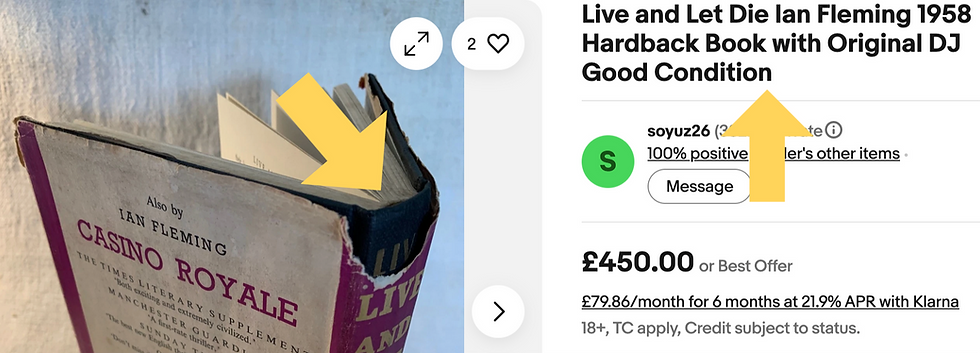
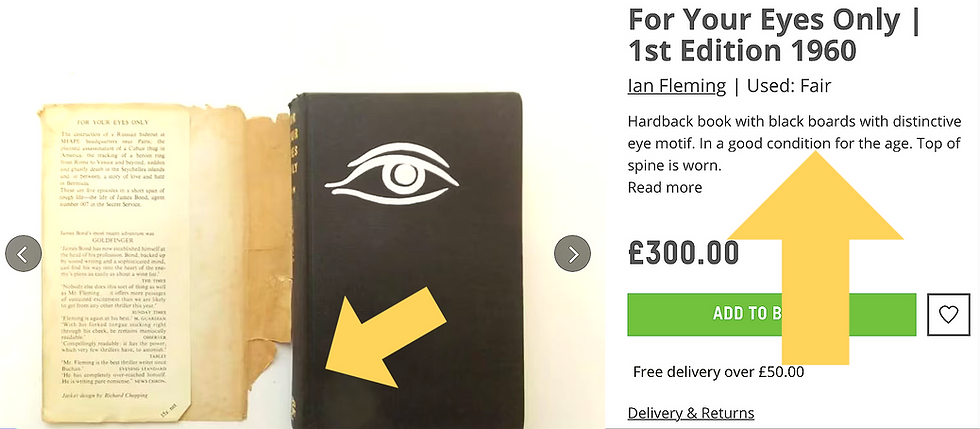
HOWEVER - While I accept that a book can be in good condition for its age, what I hate about this phrase is that it’s often used as a license to make very poor books seem better than they are.
Here are some corkers below, which attempt to justify condition as being better than it really is, just because the book is old:

What next?
Unfortunately, I think the world of describing books will always suffer from having a smattering of the imprecise, the expedient and the even the outlandish.
The saving grace, is that savvy buyers ‘should’ see through this. But I do worry if people are pushed into accepting less good books, thinking that this is the best condition they are likely to be.
I was ‘so’ wanting the Octopussy grader to have got his book more right.
But it just goes to show, that in books, subjectivity still rules.
As ever, let me know your thoughts..


Comments