Loving ex-library Bond books (Part 2)

Last week I was singing the praises of ex-library Bond books. But despite them all being deserved of more attention, there are some - I would suggest - that are better than others...

Last week’s blog was a plea for us all to fall back in love with ex-library James Bond first editions. And I for one, was both relieved and glad that it garnered such a positive response.
To my distinct pleasure, the support for last week’s piece really did prove that there ‘is’ growing regard for books that came from the library system.
And why not? For some these books still have personal meanings, or are sometimes the only affordable way of adding very early editions to their collections.
But I wrote last week’s article also with the view to it teeing-up this week’s one.
Because while I do say collectors should be more aware and appreciative of ex-library books, there are many different types of ex-library book that I think are worth showcasing.
And, dare I say it, I do think they are potentially worth putting into some form of pecking order. Because – to butcher a quote by Vespa in the 2006 film Casino Royale, “there are ex-library books, and there are ex-library books” [ie some are distinctly better than others].
To illustrate the point – take a look at all of the following books in this blog – most of them are ex-library first printings.
They are all very different, but to a large degree they showcase the steady evolution of the way libraries went about protecting their books - initially by rebinding them completely:

These complete rebinds are what I would call the 'worst' of these ex-library Bond books, and they can be illustrated in the example above, of a first impression of a Casino Royale (that I subsequently used for one of my own - better, leather rebinds).

This bland style, functional style of library binding features on many of the earliest (from the 1950s) Bond titles. Also included is this first impression ex-library example of Live and Let Die (left).
Clearly, they are reflective of a time where the books were simply not seen as having any future collectable status.
The were utilitarian.
The heavily reinforced rebinding work – with much more durable boards (often finished in an acrylic coating for extra protection) – was clearly done to protect the books from repeated, and frequent handling.
In other words, their single job was not to look nice, but to last.
But as well as these very earliest ex-library Bond books having very unflattering, but sturdy covers, another key attribute is that they tended - in virtually all cases I've seen - to have heavily trimmed pages.
The reason the books were trimmed was, I believe, to enable a stronger method of bookbinding called ‘oversewing’ – the practice of the sewing together of loose leaves to form a stronger text block.
Ironically, while this method made the book a lot more durable, it actually prevented the book from being fully opened, to lie flat. Research suggests this practice was largely stopped from around the mid 1980s onwards.

The impact of these two changes made though, was considerable.
Most obviously, it made the size of library-bound books significantly smaller - almost pocket sized.
See (left) this size comparison between two copies of Diamonds Are Forever. The right hand image is the library book.
We can see exactly what difference this makes to the printed pages inside, by taking a look at the images below of the same page across a normal Cape book, and a trimmed library one (p 199). The top image (below), is the standard Cape hardback. Underneath it we can see the library-bound one, where the top of the page has been trimmed, while the right hand margin has been significantly reduced - almost to nothing:
The evolution of library bindings
Some ex-library-bindings - even on the early books - did not comprise heavy duty stiff boards that were glazed, but comprised those with cloth bindings.
As the 1950s progressed, this seems to have been the preferred way. See below these two different first impression examples of Moonraker - only two years after Casino Royale - but each cloth-bound:
As you can also see above, the 'brown' Moonraker has also been given a speckled detail to the page block edges too - perhaps to hide marks left by grubby hands!
The cloth-binding option was clearly a hit, because it showed no sign of going out of fashion - even by the late 1950s. This example is of a library binding for Goldfinger - 1959:

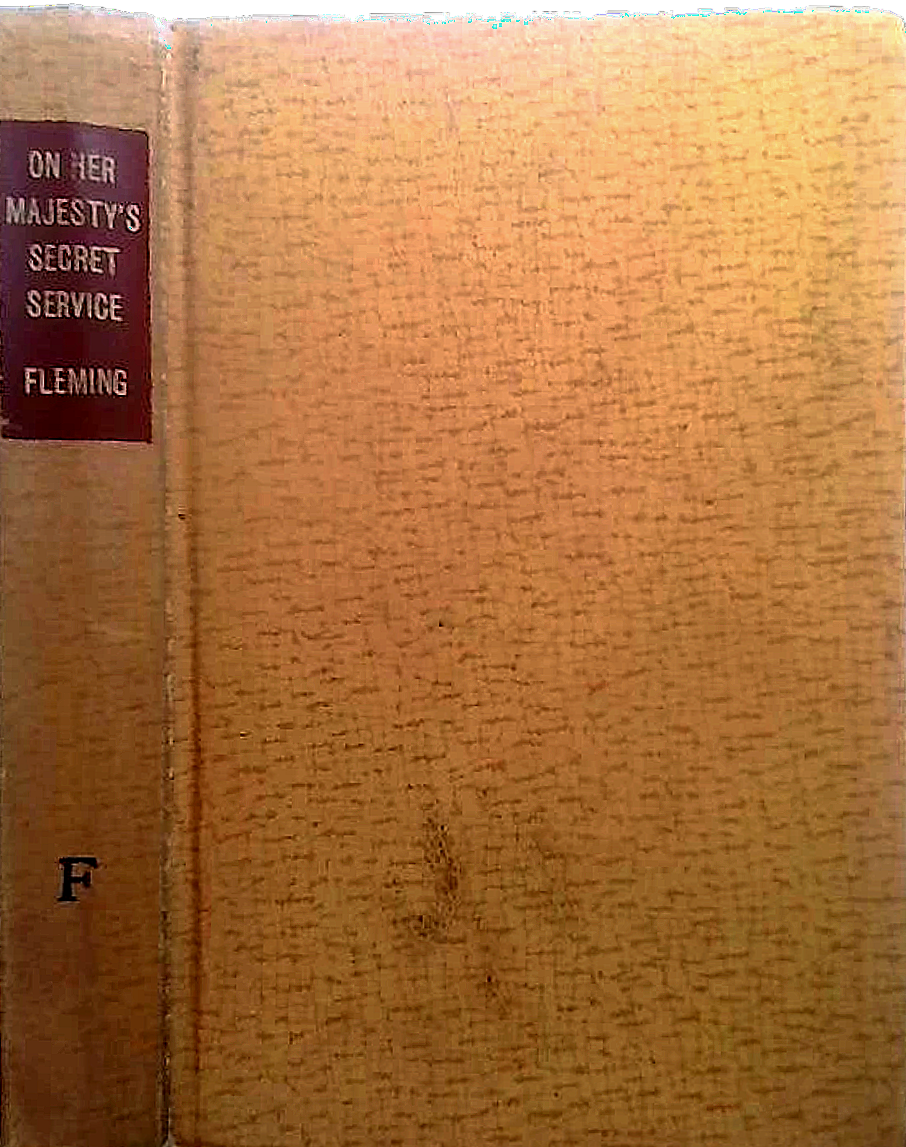
In fact, we can see that the cloth library binding was still very popular well into the early 1960s.
This (left), is a first impression (1963) of On Her Majesty's Secret Service, showing this particular library's take on the cloth bound look.
You'll notice that by this time, labels were being added to the spine for the title, rather than it being stamped directly onto the cloth as in some of the examples above.
Differences abound
Depending on your point of view, it's either charming or irritating that ex-library books can look so vastly different, and one thing is clear -they are certainly not uniform. It feels like each library - while broadly working to similar overall binding standards - sometimes had wildly different 'looks' that they were going for.
Take this hideous faux leather library rebind of a Thunderball - from the 1970s (below):
Also making appearances by the 1970s were those that had a distinct a vinyl-type look and feel to them – presumably for durability - as this Diamonds Are Forever from the mid 1970s shows:
The evolution of these bindings suggests that libraries simply experimented with different coverings as new/different materials became available, or cheaper/easier to use.
The ex-library books we'd all like to own
Somewhere along the slowly evolving timeline of the library book, however, came the collective decision ‘not’ to rebind, or trim them at all, but actually preserve the look of the book, by keeping the jacket, and simply covering in a protective plastic cover.

This example (see picture left), is a perfect example of this.
As you can see, the jacket - thanks to its protective sleeve - is in spectacular condition. Many ex-library books preserved like this are in fabulous condition.
In fact, the only exterior evidence that this is a library book at all comes from a sticker placed over the Cape urn on the spine, which shows a double agent image, indicating this is from the crime/thriller section.
These really beautifully preserved books are, I think, the ones that most people would be happy to have in their collections.
Often these same plastic-covered books also had a thin card paper backing, to further reinforce and protect the dust-jacket.
See picture below of this protective card:

So, if I were to favour owing one ex-library over another, it would definitely be the ex-library book that's had the plastic protective cover.
On shelves these are the ex-library books that essentially look no different to any standard Brodart/Mylar covered first edition. Unless you physically picked it up, the casual observer probably wouldn’t be able to tell the difference.
Just why libraries all switched to this solution was undoubtedly due to cost. A plastic cover is cheap, and in the 1980s most libraries were downsizing, and no longer keen to have an expensive, bespoke binding department.
This loss of library binding departments is probably most collectors' gain - giving today's bibliophiles a chance to own former public system books that still look as good as fine condition, very expensive ones.
I say if you're short on pennies, keeping a look out for library copies is a worthy pursuit. You may still get some very good ones...


Comments