To rebind or not to rebind? (with later boards): That is the question...

An unexpected email prompted ethical questions about the pros and cons of using the casing of a later impression James Bond book to go over a damaged first impression one....

When people tell you that 'you never know what tomorrow might bring', I’ve generally taken this with a pinch of salt.
This is because (most of the time), life as a bookseller is fairly predictable: You spend lots of time hunting books down, negotiating to buy them (sometime failing), listing them, and then hoping customers come flooding in.
On one or two occasions I’ve ‘genuinely’ been surprised by what my day has brought. One time a seller emailed me out of the blue and asked if I would like to buy his entire collection of more than 100 first editions (many signed by Bond film related actors, actresses and crew).
I was flattered, but alas I could not pick and choose the ones I wanted (it was an all or nothing sort of request), and so some time later they appeared as a dedicated sale at a high end auction house.
There’s been other occasions where a Holy Grail book has turned up and I’ve tried to buy it first. Sometimes I get it, sometime I lose out. That’s par for the course.
Recently however, I ‘did’ get an out of the blue email that definitely would get filed in the ‘I wasn’t expecting that’ category.'
And I thought I would share the story here because it was a request to do something that I had never considered before. (PS I have my customer's blessing to talk about this):
A rebind with a difference
A customer – let’s call him David – got in touch saying he had a rather unique problem, and he asked if I could help him out.
David had in his possession a first edition, first impression of Live and Let Die.
Below are the photos he sent me.
As can probably be deduced, there was one big problem with this book. Somehow, and at some point in the midst of time, this first edition had completely lost its cloth spine.
It looked as if it had been completely torn away (see picture above).
Although the front and back boards remained – they were in not very good condition, meaning what would otherwise be a very nice book to own was left looking somewhat sad and needy.
In his original message David initially asked if a replacement spine from a donor book could somehow be grafted on.
My initial response was that I didn’t think this would look very nice (and would probably ruin/devalue an already distressed-looking tome), and maybe he should do a full-one, nice complete leather rebind.
But his reply was an intriguing one. Instead of my suggestion, David wondered if it would be possible for me to rebind his first edition using the boards and spine from a later edition donor book – one as close to the publication date of the first edition as possible.
It was certainly an idea I’d never considered before. Whilst I’m almost certain this mismatch option has been done before with other books, I can’t recall seeing a Jonathan Cape hardback book ever getting this sort of Frankenstein treatment.
What was I to say?
What followed was a flow of messages - on WhatsApp. Some of them are shown below. Initially I believed new endpapers would be needed, but I was still hesitant:
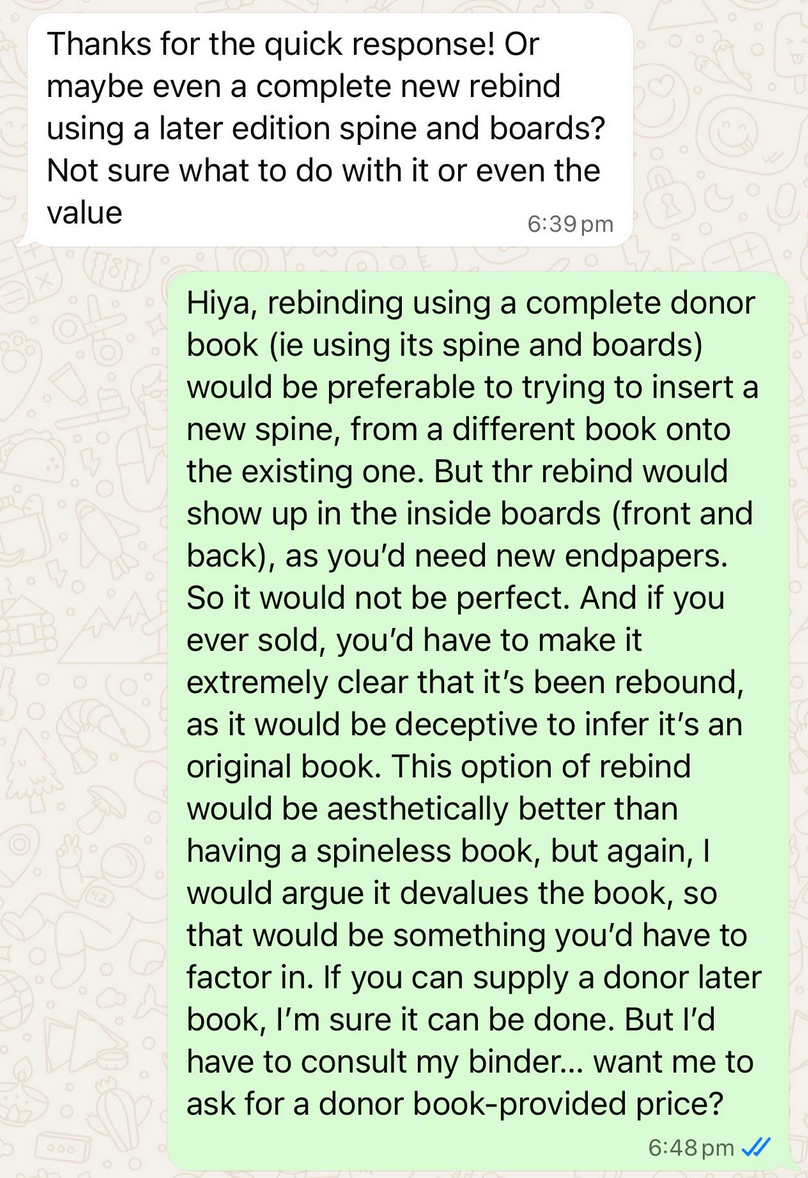

As you can see from the exchanges above, I had no doubt this ‘could’ be done, but at this point I was already raising some ethical questions. I just wasn’t sure about it.
For reference, I’ve written before about swapping jackets (something I accept happens, but which I don’t like), but swapping boards seemed like a whole new next level.
But then I thought about it some more.
I’ve also written extensively in the past about ‘survival rates’ of important books, and why it's important collectors have a responsibility to repair and restore books if it preserves their lifespan. Was this such an occasion?
After apply some more thought, I surprised myself by saying, ‘yes’ it’s very much possible, and I would pass it on to the binder that I use to do my leather rebinds.
I issued just one caveat though: To promise me that if he did ever sell this book in the future, he ‘MUST’ declare the restoration to any potential buyer.
The rebind process

The project had some elements to think about.
Most obviously, was the issue around how to deal with the front and back endpapers.
Although the first impression book still had its original endpapers (the boards were still present), after talking things through with my binder, we both agreed it would be impossible to attempt to remove the part of the endpapers glued to the boards, and then have these re-glued onto any new donor boards. The paper would almost certainly get destroyed.
The solution we opted for, however, was to use the donor book, endpapers and all.
Yes, the endpapers from any donor book would add an additional element of non-originality, but it was felt that this would be the best solution to create an overall better finish of book.
Not everything initially went to plan
So concerned were we about the practicalities of dealing with the endpapers, that my binder and I completely forgot about one key thing: the fact that later Cape printings often have a tendency to be of different spine thicknesses. (due to changes in paper quality/thickness).
In any other circumstance, this wouldn’t be a problem. But it would very much be a problem if the casing of the donor book had different spine dimensions to the first impression!
And so it was that this unexpected problem reared its head. The donor book that I was sent (which, annoying, had had its copyright page removed – so I couldn't tell you which edition it was), had a page block that was significantly slimmer than that of the first impression (see pictures below - the first impression is the top book).

The thickness difference was so pronounced in fact, that the page block on the proposed donor book (the bottom book in this photo), was just 17mm thick.
The first impression’s book, meanwhile, had a page block that was 22mm thick – a whole extra half a centimetre.
If the situation had been the other way around (ie the donor book was fatter), then maybe a workaround could have been achieved, but a slimmer donor book meant the casing of the donor book simply wouldn’t have been able to wrap around the first impression.
All over? Not quite…
At that point, I didn't think the project would be able to move on. But then David got back to me, to say he’d seen a second impression for sale online, and could we try that?
My ethical mindset kicked in again. What, destroy a perfectly good second impression, just to patch up a first impression?!!
Although I wasn’t thrilled at this prospect, he said he’d already bought it (but was waiting for it to arrive), and already wasn’t terribly attached to it. He said he ‘really’ wanted to swap boards, so could it be done with this second impression.
I said OK, let’s hope this second impression works. In my mind I thought it would have a much better chance of being the right thickness, given the second impression came out so quickly after the first print (in the same year). I awaited this new book’s arrival…
New problems
When the second impression finally arrived, the page block was everything I wanted it to me – the same thickness as the first impression book.
As you can also see, the gilt to the second impression book was significantly brighter than what was left on the first impression book, so it would really stand out:
Above: Left-right: First impression; donor book; correct thickness!
But then a new issue arose.
See the picture below… At the very top corner of the pastedown of this new donor book, there was an inscription inside the second impression, and also a date – of 1955.

Given that we’d also be using the endpapers from this donor book, the inscription would re-date it as 1955 on a 1954 book.
I needed to know if David would be happy with this.
(Secretly I was sort of pleased about this. Blank endpapers would completely hide the rebind process if done as well as I thought it would).
In my mind, the good thing about the presence of the inscription, is that it would ensure that this new combined book would now begin a conversation if ever offered up for future resale; ie about why the date of the inscription didn’t correspond to the date on the book. Of course, outwardly, it could still look like this book had been bought and written in a year later, but most inscriptions are contemporaneous to when the book is first published.
To me, should any future sellers ‘forget’ to mention that this was a rebind, this would alert any buyer to the potential that this had occurred.
It seemed like a good safety net to leave the book with. David said it was happy, so he was OK to proceed.
The finished article
Within a couple of weeks, the book had been rebound – see the pictures below – and I think my binder did an absolutely smashing job.
The entire casing – complete with tipped-in front and back endpapers have been expertly joined to the first edition book. Close inspection will show that this happened, but the overall look and feel the customer has wanted was – to my mind – expertly achieved.
And below is how this book looks in its jacket too - courtesy of my customer sending pics through when he received to rebound book:
What are your thoughts?
So...what do people make of this?
I suspect there will be those who will sonorously argue that this rebind shouldn’t have been done in the first place.
To a degree I get it.
Whilst I have my buyer’s word that he will disclose these modifications to any future buyer – I'm well aware that promise can be broken/forgotten about, and that any future owners after the next one, might not be so honest, or could also just forget about it.
Technically, some years into the future, someone could very well end up buying a first impression that actually has a the boards of a second impression over the block – and I’ll be responsible for it (sort of).
Even if the current owner owns this book for the rest of his life, I doubt very much that instructions will be left for his descendants to follow, when dealing with his estate. So, I reluctantly accept, that eventually this book could well end up being represented as something it is not.
But then again, what about the preservation aspect?
Books are bound, rebound, and re-housed all the time. It’s what keeps them surviving, and doing what they were supposed to do – give readers pleasure.
This book will be giving someone pleasure for years to come. As it stood before, it would have probably disintegrated and become useless. And remember, this is a numerically scarce book. It would be sad for the remaining numbers of any rare book to be reduced by one
There will no doubt be supporters of both points of view. But maybe there be a just-as-large group of people who are on the fence, not exactly sure what to think.
It’s weird. With books there’s always a worry about whether we are doing the ‘right thing’ by them, in a way that we don’t seem to apply to other inanimate objects. This activity has very much revealed this.
I think we worry about what to do with our books because we all know books are still deemed important to people. We would rather hoard them then see them destroyed; we would rather give them to someone else to read, rather than bin. We all want our books to live on, long after us.
This book certainly will. Let me know what you think!


Comments