Working out what's still left: Is it a case of 'survival of the finest'?

We can't always work out overall survival rates, but what about working out survival rates of the best possible condition examples of the James Bond first editions?
Anyone who’s into their cars will probably already know about a great little website called www.howmanyleft.co.uk.

It's beautifully simplistic. Type in the make and model of any car that’s ever existed, and almost instantly you can see just how many of them are still left purring on Britain’s roads.
Obviously, I couldn’t resist typing in Aston Martin DB5. A split second later, it revealed that as of Q4 of 2025, there were 296 running examples, while a further 83 were declared as being SORN (off-road).

Given that we know the DB5 had a production period of just two years (1963-65) – during which time 1,059 cars were built – from this website we can quite easily work out that of this total number produced, a decent 379, or 38% still exist today. Survival rate calculation: simple!
If only things were that easy when it comes to rare books!
For some time now, I’ve been crusading for collectors/the trade to recognise that assumed survival rates of books really ought to matter more than out-of-date original production numbers. These original print numbers are still referred to in catalogues, but they are numbers that are only ever correct once: at the very point in time that they were all actually printed and bound.
For just like cars can be crashed, written off, and crushed, it’s always seemed obvious to me that as soon as books get sold, then ‘wastage’ (as booksellers often call it), inevitably happens. This is the natural decline in surviving examples, due to damage, fire, flood, being thrown away, or destroyed in some other fashion.
To me, still relying on the contemporary print numbers of each Ian Fleming book to gauge rarity (and ultimately price), seems crazy.
For instance, we’re all told to accept that Live and Let Die (whose first impression print run was 7,500) is rarer than Moonraker – simply because Moonraker had a first impression print run of 9,900.
But for all we know, it could be Moonraker that is actually the more scarce ‘today’, because this might be the book that has the lower survival rate compared to Live and Let Die – even though it’s original print run was nearly 25% smaller.
The reality, of course, is that it is almost impossible to say with any certainty what the survival rates are of each of the 14 Bond books. The only category of book where it can be done is with the signed On Her Majesty’s Secret Service special edition – because here the sample size of books (285), is small enough to work with, and each book is demonstrably unique and identifiable – via is number, or signature variation.
Having a go at predicting survival rates
But having said all of this, I’ve sometimes wondered whether it 'is' possible to try and have a go at determining survival rates for specific Bond books, especially if we chose to use a different measure – for example, survival rates of near-fine to fine copies.
I think this is a valid metric to try and use, because as someone who relentlessly searches for the most perfect books I can, all this time spent and knowledge gained has got to be worth something in terms of it giving me a sense of how many copies, out of every 100 (for example), that are in really nice, near-fine or fine condition.

The best book I can think of to illustrate this is For Your Eyes Only.
This is a book that – on paper at least – is in the second half of Bond books in terms of overall numerical scarcity. With its print run of 21,700, it’s officially only the 8th rarest of all the 14 books.
But as I (and most collectors), will well know, this book that ranks amongst the hardest (or is possibly ‘the’ hardest) to find in near-fine condition or better.
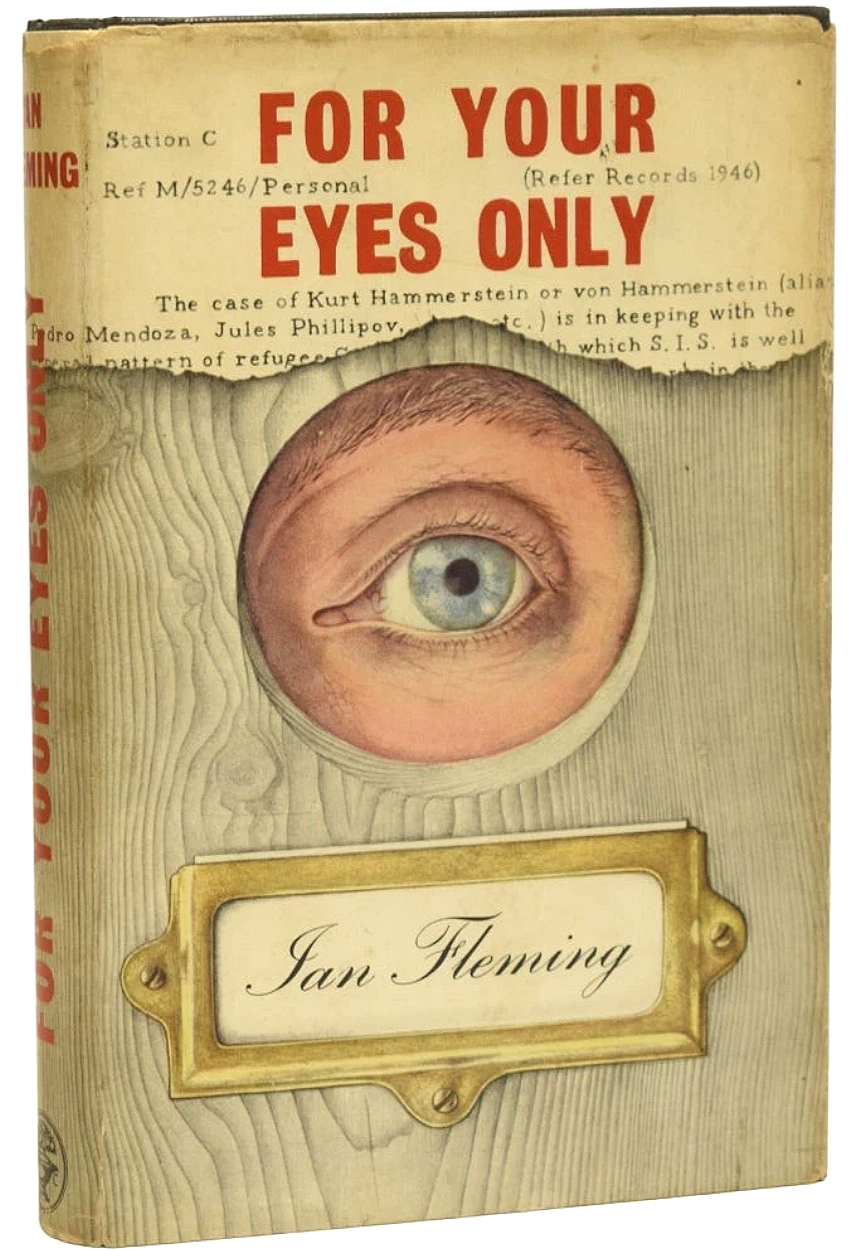
This is thanks to the fact that dust-jacketed copies are almost always found with the lettering on spine no longer showing the deep red it is supposed to have (and which should match the face of the jacket). More often than not, the spine is so impacted by sun exposure that the red has transitioned to an orange colour. Even worse, are examples where almost all of the original printed colour has been bleached to resemble a yellow.
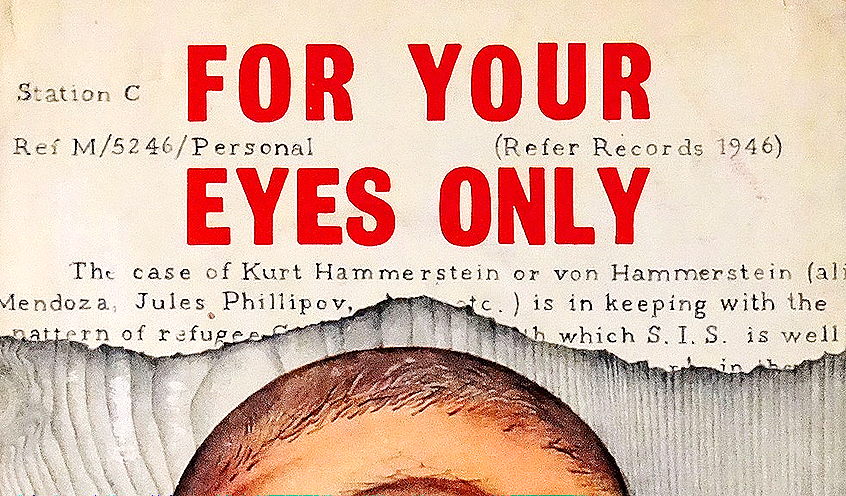
As an indication of just how difficult it is to find a very good examples of this book - with the red still vivid - even this picture above (from a Sotheby's listing, priced at $2,500 - and sold), isn't perfect, with the red looking more orange in colour than anything else. (Although for better examples, see the very end of this blog).
But don't just take my word for it. Below is a visual representation of what I’m talking about.
Using eBay as a first port of call, at the time of writing (10th June 2026), I could find just 10 examples of first edition, first impression For Your Eyes Only books – that is books that were complete with their correct first impression jackets.
Pictured together, (apologies for the quality of the photos – these were the best I could get), they resemble something of a rogues’ gallery of books in what I would describe as being in poor, to only average condition. I've also tried to order them from yellow, to orange, to less red:
This Harrington's book (bottom left), is possibly the best of the bunch, although it's not giving buyers much confidence by slightly hiding the spine, and not showing it off to its fullest potential.
If I were a guessing man, I would say this book is still (most likely), more on the orange-red side rather than having blood red spine lettering, and that's why the spine isn't shown as full-on as one might hope it to be.
So, that's ten books, and none of them are what I would call near original 'red lettering' condition on the jacket spine.
Obviously, eBay isn't always the place to find high-end books. So next I searched Abe which was a little better (although not dramatically).
Set the search criteria for ‘books’, ‘hardcover’, ‘dust jacket’ and ‘seller supplied images’, and after dismissing matches that aren’t relevant (like later impressions, those part of complete sets, omnibus editions, FELs, non-Cape publishers and those that are also shown in eBay listed ones above), and you end up with just 32 books.
In the main, it's the same issue - mostly books where the dust jackets are yellow-orange in colour. Here are some of the main ones for reference:
The Abe yellows:
Shockingly, the jacket folded out fully below (right), was described as being 'near-fine':
The Abe 'oranges':
The Abe 'yellow-orange' examples (complete with very wide-ranging pricing):
The Abe 'Getting redder':

Of 'all' the listings on Abe, however, the only examples that I would remotely class as having original red lettering on their jacket spines were just these three examples. Here you can see how they are significantly different from the others shown above.

Very low survival rates of 'near fine' condition books:
Based on what I've been able to find on just Abe and eBay, I make that 42 books found in total, where I can definitely see the spine.
And, of these, I would say just three have the desired red spine lettering.
Converting 3 out of 42 to a percentage, and that's a very low 7% of all the books for sale on these two platforms as having what I would consider to be a good red spine.
If we assume that this is a representative sample, including this sample being representative of survival rates too, then by appylying that 7% to the total first impression print run of 21,700 books, it's possible to speculate that only 1,519 books (7% of 21,700), still exist with jacket lettering in the desired deep colour.
This may not be 100% accurate, and I maybe even think that this is an over-estimation, but I think this is a decent stab as guesstimating survival rates of this particular book in very good condition.
In doing so, I also believe it means we all need to re-frame our mental picture about which James Bond first editions should be considered rarest to find in very good or better condition and (yes, because price is always relevant), what the cost of acquiring these books should be.
What's your opinion about this estimate?
I think that as an experiment in working out survival rates of the best condition examples of this particular title, it's a decent first stab.
Yes, I think the methodology could probably be a bit more refined, but I'm happy in saying that if you want a really red-spined example of this book, you've got to know that you're now fishing from a smaller pond than you might have necessary thought, of around 1,500 books.
We might additionally be able to say that of these surviving 1,500 or so copies, high numbers are likely to permanently reside in private collections. Numbers that have survived are one thing, but for certain, the numbers of red-spined books that are actually, right now available to buy are very low indeed - maybe just a few handful if you add what specialist book dealers have outside of Abe.
Have a look at www.jamesbondfirsteditions.co.uk's offering:
At this point, and the end this blog, it would obviously be remiss of me not to signal a recent find by www.jamesbondfirsteditions.co.uk - which will be going up for sale imminently.
I believe it meets the requirements of being one of the very rarest 'red' spine examples.
This book is so newly arrived (it was the inspiration for writing this blog), that I'm writing about it here first, before officially cataloguing it - so if it's not yet up on the dedicated 'For Your Eyes Only' tab, do get in touch directly at enquiries@jamesbondfirsteditions.co.uk
It's got some minor rubbing, but it's red.
And - as I think we have just established - that means it's rare!


Comments