Condition: Book collectors still can't find definitive definitions

John Carter's 'ABC for Book Collectors' spends the most time talking about 'condition' but still leaves more questions than answers:

Given so much time is spent by book collectors obsessing about ‘condition’, it’s perhaps no surprise that when it comes to John Carter’s seminal work - ‘ABC For Book Collectors’ – ‘condition’ is the entry that has the longest explanation when found in the ‘C’ section of his A-Z compendium – at least that's the case in my trusty 1973 reprint.

For those of you don’t know it, the ‘ABC For Book Collectors’ is where collectors go to understand their ‘imprint’ from their 'pallet’ and their ‘quarter bound’ from their ‘secondary binding’ and everything in-between – and my copy (see picture, left), has been a trusty source of wit, information, and interest to dip in and out of for some time.
First printed in September 1952, on the eve of the publication of Casino Royale, the original 500-plus entries were compiled by the former assistant at American publisher, Scribner’s, who later worked for Sotheby’s establishing its New York Office – the first for a British auction house.
And – because the Fleming family are never far from the book scene it seems – Carter also served on the board of directors of the journal, The Book Collector, now published by Queen Anne Press, the limited edition publishing arm initially managed by Ian Fleming himself (and run today by his nephew Fergus Fleming).
For those who have never seen it, I would thoroughly recommend finding a copy (they are easy to find on eBay).

The tome has a rare ability of being able to converts dense bibliographical information into readable, sometimes entertaining text for book collectors – and it has since gone through a number of revisions over time – the most recent of which was printed only a couple of years ago in 2024 (see picture, left), under the editorship of Nicolas Barker.
Barker was the former editor of The Book Collector (from 1965-2016), before Ian Fleming’s other nephew, James Fleming took over, who ran it until his recent passing.
Anyway, I digress – back to ‘condition’.
Despite Carter later becoming president of the Bibliographic Society in 1968, his observations (in my edition at least), around condition are certainly interesting.
He says: “After the importance of a book…the two most urgent considerations in the mind of the book-seller (note seller, not buyer) are probably (a) the rarity of the edition and (b) the condition of the copy. And by condition he means a good deal more than the volume’s superficial physical appearance; for the term covers the completeness and integrity of its contents and well as the beauty or appropriateness or originality and the state of preservation of the covering.”
Carter noted – even in the 1970s – how 30 years earlier, the respected novelist bibliographer, and former president of the Bibliographical Society, Michael Sadleir, had argued that ‘condition more than anything else nowadays dictates value and will continue to dictate it.’
While these views are arguably unsurprising to collectors today, what is more interesting to me, is that while determining that condition is everything (or nearly everything), Carter actually stops short of defining condition very clearly.
He says: “Each man will adopt his own attitude to this crucial and [here’s the key word…] highly subjective factor, and for the sensible man it will be elastic rather than rigid.”
Why is condition still so elastic/subjective?
I find this really quite odd, because as I’ve banged on about plenty of times before, condition really ought to be something that should be more black and white. When our eyes tell us a book is dog-eared or torn, in my view, it’s difficult to describe it as being in good or better condition.
Carter goes on to suggest that the fastidious collector will “apply his own taste and judgement to a number of niceties,” – again odd I think. Do only fastidious people see ‘condition’ differently to anyone else?
Condition being relative
Perhaps the most intriguing observation from Carter is his suggestion that condition should be relative, and that issues (like torn jackets) should be excused, otherwise the collector should “resign himself to never possessing a copy at all.”
To me thought, this feel slightly wrong, and is conflating accepting a lower condition book for the sake of being able to own it, with condition itself. The two – I think – are different.
Carter also quotes Percy Muir – the bookseller who curated a young Ian Fleming’s own personal book collection – who said: “I would take an ex-library copy rather than none at all.” But this is (to me), more a conversation about what a collector is willing to accommodate in their collection. This condition it is in should be a separate conversation.
What is condition (really)?
Despite Carter’s circuitous reflections thus far, condition is – actually – a recognised bibliographic term.
And in his introduction to the book, he accepts that it is useful to try and define as many terms as possible to try and better firm up what he refers to as bookseller “jargon” – “most of which is unintelligible to the layman.”
So what are his definitions?
Collectors, he says, do need to know how something “briefly described in the catalogue of a bookseller two hundred miles away,” translate to the eye.
However, the only discernible answer I can find, is being alert to what he calls booksellers tendency to use adjectives that are ‘enthusiastic’ as opposed to ‘descriptive’ – something where we can both agree that use of the former can sometimes misrepresent.
Here are his adjectives of ‘description’ (see picture below). In theory these are words that are quite precise – and he breaks them down into being descriptions of a book in general, and then its exterior and its interior particulars:
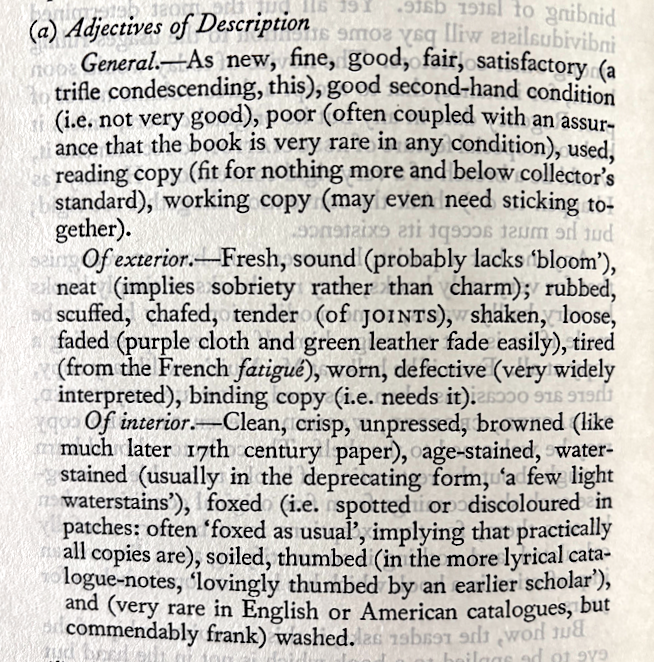
Interestingly though, if you read the above, what I'm sure you'll find is that quite a few of them are what I would regard as imprecise: words like ‘fair’ and ‘satisfactory’.
Words like ‘fresh’ and ‘sound’ are also much less precise than some of the others he lists, like ‘rubbed or scuffed’. ‘
Tired’ is a little more subjective in my view, certainly more-so than ‘worn’.
I find that the interior descriptive words – those like ‘clean’ and ‘foxed’ and ‘age-stained’ work much better for me, as there is no real room for disagreement or stretching the truth with these.
By contrast, his adjectives of enthusiasm are words like: ‘immaculate, ‘pristine’ and ‘mint’.
Arguably though, I would say these sound more precise than some of his descriptive adjectives – those that are supposedly more acceptable.
I personally think ‘mint’ and ‘immaculate’ for example, are widely understand, and don’t have too much elasticity of meaning.
Condition is a word that still confuses
Clearly, condition is a word that despite attempts to define it better, still has a aura of imprecision about it.
To fair to Carter, he says his book is about commenting on words and phrases “commonly used in book collecting.” He claimed his book was “not an ABC of bibliography,” but an “ABC of collecting.”
Having read the book, and picking up on his very evident dry sense of humour, you rather suspect ‘condition’ is one of those terms that he actually secretly dislikes, precisely because it is so subjective, but more than that, also often used to mislead, and in his book he only wants to deal with facts.
An early indication of this is the inclusion of the term ‘As usual’ in the ‘A’ section. He rather disparagingly refers to it as “a favourite qualification among booksellers, to the admission of some defect or imperfection which is, or can be maintained to be so prevalent as to be almost normal among copies of the book described.”
Here, the not-so-subtle inference, is that this is a term his dislikes, and that he particularly dislikes booksellers using it with alacrity, when really, they should be dealing with hard and fast definable facts. [He implies that he much prefers the phrase ‘As issued’ – because at least this related to, and emphasises what he refers to a ‘original condition’ – denoting specific, observable elements – such as it having untrimmed edges, or without a wrapper, or stitched in a particular way.
Original Condition only
I think Carter is really most interested in is ‘Original Condition’.
However, all is not what it seems, as this is not explained as we would expect it to.
Rather than if referring to what modern collectors would think of it as (ie whether it’s dog-eared or not, fine, versus average etc..), Carter instead argues it refers to anything (such as the type of cloth it’s bound in, or whether there is a dust jacket or not, “for which the quality of originality can be claimed.”
In other words, he’s using it to distinguish between books that have maybe been later rebound, of different in some way to how they were originally produced – not to determine degradation over time from this ‘original condition’.
So again, we see an almost deliberate attempt not to engage with any of the true vagaries of condition.
Where are we now?
The fact condition is still debated can be shown in this clip here, from US-based rare book dealer, Rebecca Romney, where her own difference of opinion is that the book she is holding is 'rubbed' rather than 'soiled' (these words are often used interchangeably).
As you can see, even amongst dealers there is a certain level internal debate about certain words.
Regular readers of my blogs will know that in the past I’ve blogged about why condition descriptions need to be taken with a pinch of salt, and even whether more comic-book style gradation is needed to take the subjectivity out of it, and clearly, condition was as much an issue in the 1950s as it was the present day.
This is what you think is a condition reference, in the ‘I’ section of my ABC book, where Carter has an entry for ‘Imperfect’ – but again this is another red herring.
Actually Carter talks about this as imperfection to the binding itself (ie absent half titles, or blank sheets when there should be). The same applies to ‘Defective’ – a term denoting often used with something else more specific – like ‘backstrip defective.’
Maybe Carter's attempt at descriptive vs enthusiastic descriptions of condition was a far as he wanted to go.
Personally, I don’t blame him, but annoyingly I wish he had been more prescriptive about his thoughts on the matter, because if there’s one thing we can agree on, it’s the fact condition is still as big a debating point now as it was back then.


Comments