Signet's sometimes forgotten illustrator

Updated: Dec 10, 2025
Think James Bond cover art, and one name - Richard Chopping - normally comes to mind. But I've always had a soft spot for Barye Phillips - Signet's paperback artist. And last week two of his original James Bond cover art paintings went under the hammer...
In case you haven’t spotted them yet, jamesbondfirsteditions.co.uk has recently acquired some rather excellent examples of the earliest Signet US paperbacks – all first prints, and all the first time the Ian Fleming novels appeared in paperback form in America (including Casino Royale, Diamonds Are Forever and ‘Too Hot to Handle – aka Moonraker).
See what I currently have here.
Maybe it’s because I’m based in the UK, and because the Pan paperbacks feel a bit too commonplace, but I’ve always had a penchant for the US paperback books.
To a Brit, they’ve always felt a bit more extravagant; a bit more mysterious; and a bit more atypical, and of course, with the Atlantic Ocean separating us, a bit rarer and harder to get hold of.
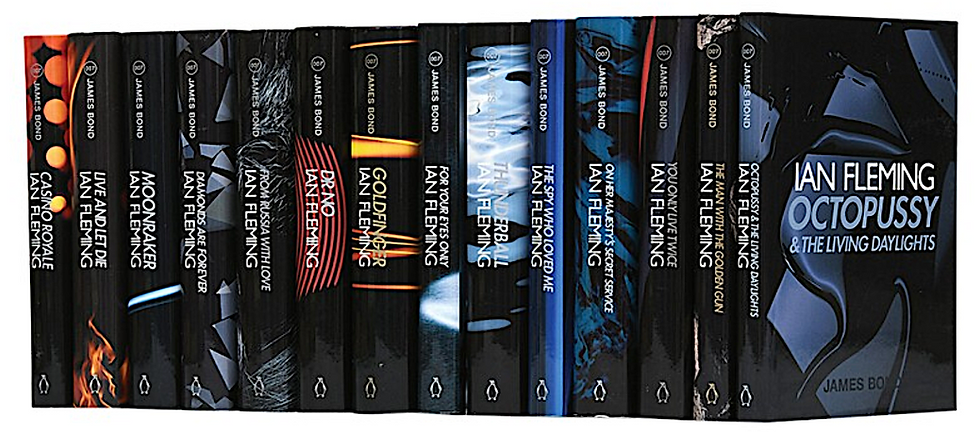
That’s why in the New Year I’ll be listing some more of these titles – everything from Casino Royale, to Live and Let Die, to Goldfinger, Dr No, and some of the later ones – You Only Twice, The Man With The Golden Gun, and Octopussy & The Living Daylights.
Being US books, they are less easy to find here in Britain, and for that reason alone, I see them as something of a challenge to try and get, and be able to offer collectors.
But I mention these Signets not just because I’ll soon be listing some more, but also because I was reminded last week about just how coveted and revered the artwork for these books is, especially after I saw two pieces of original Signet paperback Bond artwork go under the hammer in America, by artist Barye Phillips.
Signet artwork goes under the hammer
All of the Signet paperbacks that featured actual illustrations were painted by renowned illustrator, Barye Phillips (1924–1969) – a name that when compared to Richard Chopping (who draw most of the Jonathan Cape hardbacks), is scandalously far less well known.
(Note: Just three of the Signet titles did not feature Phillips – one was Octopussy – which featured a photograph of Fleming, and the other two being On Her Majesty’s Secret Service and You Only Live Twice, which were more icon-led rather than illustrated).
To me, the lack of popular recognition of this artist is a great shame, as it’s Phillips’ artwork on the US paperbacks that has always excited me – especially the very early ones (starting with From Russia With Love in 1958, through to For Your Eyes Only in 1961 - see pics above).
Phillips initially worked for Columbia Picture’s advertising department in the early 1940s, before being "discovered" by Sol Immerman (art director at Pocket Books), who was looking for someone who could do "beautiful women with low necklines" for the covers of historical novels.

Once ‘found’ Phillips was, from around 1943 onwards, a prolific cover artist, often turning out up to four covers ‘per week’ – speed that gave him the nickname of the ‘King of Paperbacks’. (see some of the covers above and left).
Famed for his cover illustrations for hundreds of pulp magazines and paperbacks, Phillips painted for all the top publishers at the time – Popular Library, Bantam Books, Cardinal Books, Dell Books, Royal Books, Pocket Books and, of course, Signet Books.
He mixed the sensual with the sinister expertly, as shown by For Your Eyes Only in particular, as well as From Russia With Love and Casino Royale, and last week two of his original works of art came up for auction at Heritage Fine Auctions.
Up for auction
Artwork of Phillips comes up very rarely indeed – in fact, it’s not known where all of it is. We know that Phillips presented the cover art for the 1961 Signet Diamonds Are Forever to Ian Fleming himself, but after that, information on where the rest of it is, is non-existent.
So it was genuinely interesting to see two lots come up.
Both were for books that were part of the 1961 onwards Signet set of paperbacks – books that by this time were given a far more uniform feel to those that had appeared before.
All of the artwork for this set features far more shrunken images, positioned across the lower third of the book, with the giant words ‘Ian Fleming’ dominating the top of the book, and the title being under the illustration. Each of these books also had downward vertical text to the right hand side, saying ‘A James Bond Adventure’.
Goldfinger:
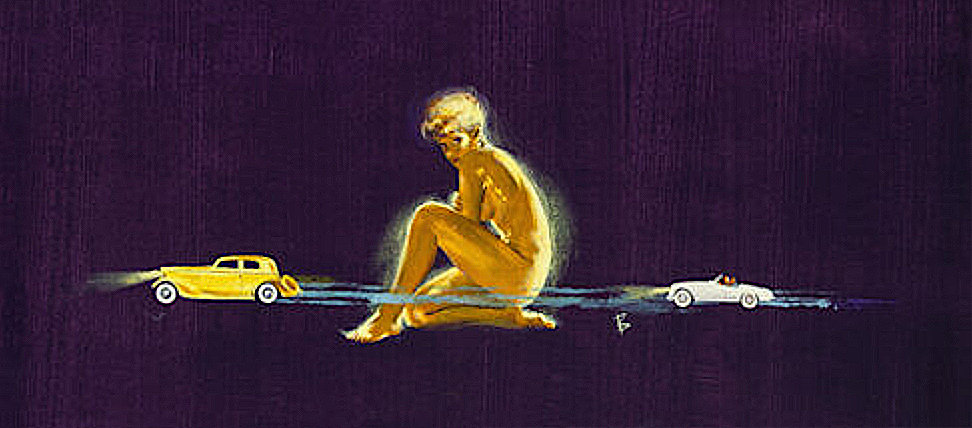
The first artwork for sale was for the cover art for the 1962 Signet paperback of Goldfinger (see pics above) - overall size: 35 x 25 inches - which was a newer version of a similar painting used for the 1960 Signet paperback of Goldfinger.

The original 1960 artwork (see left) featured a much larger close-up of a crouching ‘gold’ girl, with Goldfinger's and Bond’s cars respectively, with Bond in pursuit.
In the 1962 version, we see a very similar crouching girl, although this time she’s a bit more upright, looking more face-on to the reader, with her left leg slightly outstretched, and basically, a bit more ‘sexy’. The same cars are shown, with Bond dutifully following.
But the image on the 1962 book is designed such that it is much smaller and far less prominent.
The price this painting made was a staggering $24,000.
Thunderball:
Also in the same auction, was the cover art for Thunderball – also in the same ‘A James Bond Thriller Series’.
This time, we’re under water. There’s a terrified blond-haired girl, with a divers’ mask on, and an underwater frogman.
Once more, the painting sold for an amazingly high price: $9,000.
Believe it or not, both painting were only given guide prices of a few hundred dollars!
It just goes to show how much these works were badly under-estimated!
Artwork draws you in
As someone for whom Bond book collecting/dealing began by being presented with the beguiling cover art, I would have dearly loved to bid on these – but as shown by the hammer prices realised, there’s a whole body of fans devoted enough to drop very big numbers to be able to own this artwork themselves.
I feel that the paintings that sold last week – which are actually very large – have their own beauty to them.
But I do wonder whether Phillips must have been a little underwhelmed to have seen these quite large-scale images reduced to almost thumbnail-sized images on the resulting covers.
By the 1960s, we can clearly see the dominance of lettering over art-work – and with these Signet titles, the start of the end of using paintings altogether.
The fact Signet chose to use the artwork so small on their ‘James Bond Adventure’ series is a shame.
It did it for all the books in the 1960s, and I feel the artwork isn't given its due prominence or its due respect. See below...
Compare this to the much full-sized artwork - see below - which was used for Live and Let Die. Even though the lettering is also large, the picture still fills the whole size of the book.
If you also like this art, alas, the only option for us mere mortals is to buy the Signet paperbacks themselves.
That's as close as we're likely to get to them, but we just might need to get our magnifying glasses out to fully appreciate their detail!
Watch out for my new Signet first print paperback listings that I’ll put up over the Christmas break…


Comments